

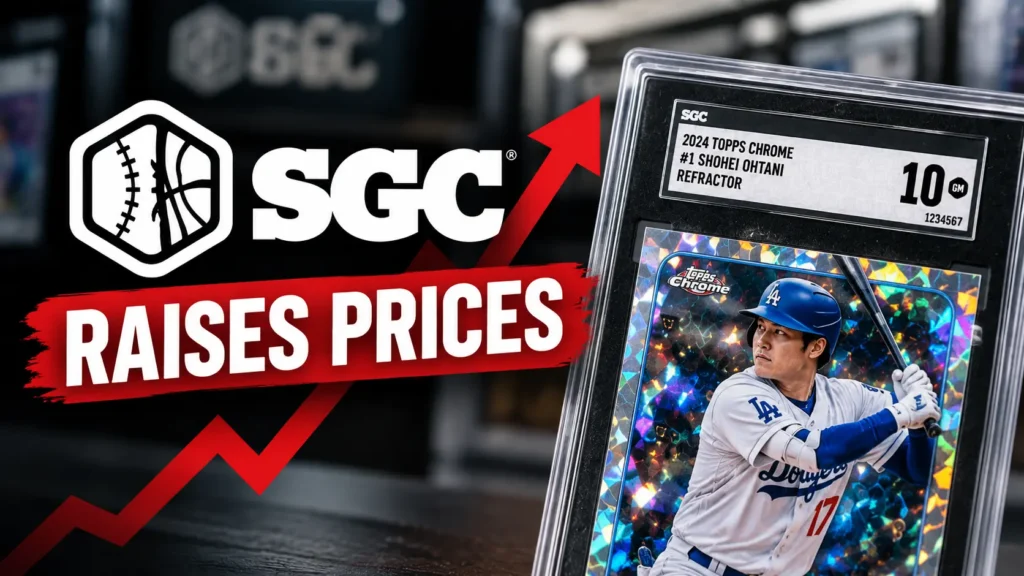
The sports card grading industry continues to become more expensive, and collectors are once again being asked to pay the price.
SGC has raised the price of its lowest grading tier from $18 to $50 per card, effective September 2, 2026. At the same time, SGC has adjusted its service levels as it deals with what it says is rapidly increasing demand and growing turnaround times.
A $32 increase might not sound enormous until you look at the percentage.
It’s a 178% increase over SGC’s previous $18 price.
And that’s a significant change for a company that had become one of the hobby’s most attractive alternatives for collectors who didn’t want to spend PSA-level money on grading.
SGC’s Cheapest Grading Service Is Now $50
Under SGC’s new pricing structure, standard grading for cards with a maximum declared value of $1,500 now costs $50 per card, with an estimated turnaround of 40+ business days.
The current standard pricing is:
| Declared Value | SGC Standard | Estimated Turnaround |
|---|---|---|
| Up to $1,500 | $50 | 40+ business days |
| Up to $3,500 | $85 | 40+ business days |
For cards worth more than $3,500, collectors have to move into SGC’s expedited services, which begin at $150. Those expedited services have an estimated turnaround of 2–3 business days.
That’s a very different value proposition from the SGC that many collectors became accustomed to.
The $18 SGC Grade Was One of the Hobby’s Best Values
There was a time when SGC offered a compelling alternative to PSA.
Collectors could submit lower- and mid-value cards without spending a huge percentage of the card’s value on grading.
That mattered.
If you had a $50 raw card that you thought could become a $150 or $200 graded card, spending $18 to find out wasn’t unreasonable.
At $50?
The math changes dramatically.
A collector now needs to think much more carefully before submitting a card.
And that’s exactly what makes this increase so damaging to the hobby.
What Happened to the $18 Card?
Consider a relatively common situation.
You have a raw card worth $40.
You believe it could receive a 10 and potentially sell for $100.
Previously:
$40 card + $18 grading = $58 invested
That’s a reasonable gamble.
Now:
$40 card + $50 grading = $90 invested
And that’s before shipping, insurance and selling fees.
Suddenly, the card needs to perform extremely well just to justify the grading expense.
That’s going to eliminate a huge number of cards from the grading pool.
SGC Says Demand Is the Problem
SGC says the changes are necessary because of rapidly increasing demand and continued expansion of estimated turnaround times.
The company says it is:
- aggressively hiring
- expanding its operational space
- investing in technology and infrastructure
SGC says the goal is to get cards back to collectors faster without sacrificing grading quality or accuracy.
And to be fair, this isn’t an unreasonable explanation.
The grading industry has been dealing with enormous submission volumes.
PSA has experienced its own massive backlog, while other graders have also adjusted pricing and availability in response to demand.
The problem is that collectors are getting hit from both directions.
They’re paying more and waiting longer.
The Grading Industry Has a Bigger Problem
SGC’s announcement comes at a particularly bad time for collectors.
PSA has already been dealing with an enormous backlog and has suspended some of its lower-cost grading tiers.
Beckett has also adjusted its service availability.
And now SGC, which was increasingly becoming the affordable alternative, has dramatically increased its entry-level price.
The result?
The bottom end of the grading market is disappearing.
That isn’t necessarily good for collectors.
Not Every Card Needs to Be Graded
There’s an important lesson here.
You don’t need to grade every card.
In fact, the increasing cost of grading makes that advice more important than ever.
Collectors should be asking:
Will grading actually add enough value to this card to justify the cost?
If the answer is no, leave it raw.
That may be particularly true for cards worth less than $100.
There are certainly exceptions. Some cards are worth grading for personal collection purposes regardless of their financial value.
But if you’re grading strictly as an investment decision, the math needs to work.
This Could Actually Help the Raw Card Market
There’s an interesting potential consequence to all of this.
If grading becomes too expensive, more collectors may simply stop grading cards.
That could mean more desirable cards remain raw.
For years, the hobby has increasingly pushed collectors toward the idea that a card isn’t truly valuable unless it’s inside a slab.
That’s not necessarily true.
A great card is still a great card without a plastic case around it.
And if the cost of professional grading continues to rise, collectors may start placing more emphasis on the actual card rather than the label.
The Big Question: What About CGC?
This is where collectors have another option.
CGC Cards has become an increasingly interesting alternative for collectors looking for professional grading without paying PSA prices.
That’s particularly important right now.
With PSA’s lower-cost tiers restricted and SGC’s entry-level service jumping to $50, CGC can make sense for collectors who don’t necessarily need a PSA slab.
Of course, the resale market still generally gives PSA the strongest premium, so collectors should understand the difference between grading quality, cost and resale value.
Those are three separate considerations.
Don’t automatically assume the most expensive grading company is the best choice for every card.