

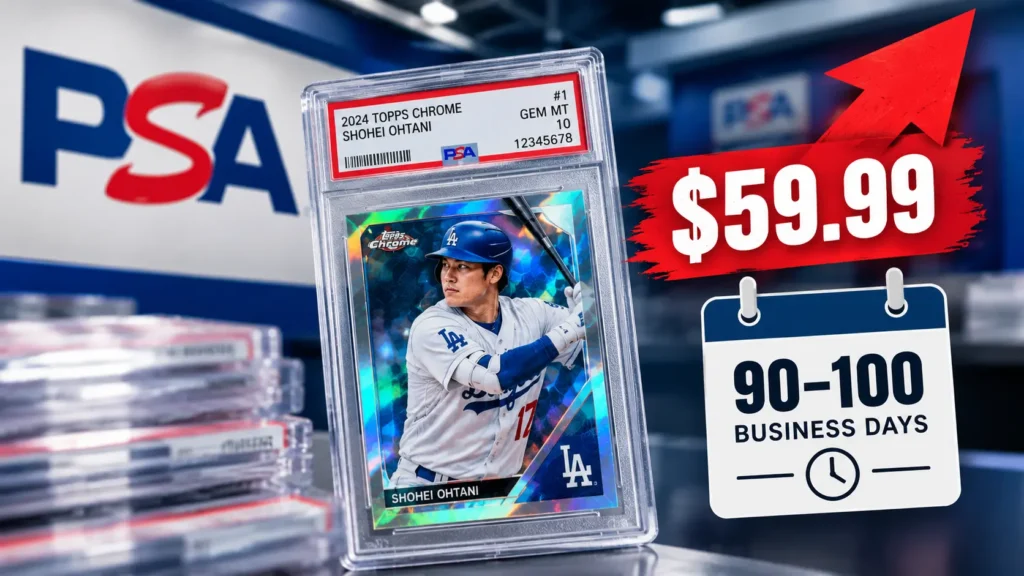
PSA is finally bringing back a lower-priced grading option, but collectors expecting a return to the affordable grading environment that existed before PSA’s massive backlog may be disappointed.
On September 9, PSA announced a new Standard service level priced at $59.99 per card, with an estimated turnaround of 90–100 business days and a maximum insured value of $1,000. The new tier opens September 14.
That is certainly better than having the lower-cost Value tiers completely unavailable. But calling $59.99 a “lower price point” also illustrates just how far the grading market has shifted.
PSA’s New Standard Tier Opens September 14
The new Standard service will accept submissions beginning September 14, 2026.
The details:
| Service | Price | Estimated Turnaround | Max Insured Value |
|---|---|---|---|
| Standard | $59.99 | 90–100 business days | $1,000 |
| Priority | $79.99 | 70–80 business days | $1,500 |
| Express | $199 | 20–30 business days | $2,500 |
| Premier | $599 | 7–10 business days | $10,000 |
PSA says Standard orders will be processed after existing Value and Bulk orders, meaning the advertised 90–100 business-day estimate should not necessarily be interpreted as “your card will be back in roughly four months from the day you submit it.”
That’s an important distinction for collectors considering whether to send in a large stack of cards.
$59.99 Is the New “Affordable” Tier
This is probably the biggest story here.
PSA’s Standard service is being positioned as the company’s new lower-priced option, but $59.99 per card is still a significant amount of money for ordinary cards.
If you submit:
- 10 cards: $599.90
- 20 cards: $1,199.80
- 50 cards: $2,999.50
- 100 cards: $5,999
And that’s before shipping, insurance and any applicable taxes or other fees.
For a $50 raw card, spending $60 just to have it graded doesn’t make much economic sense unless you’re betting heavily on a significant increase in value after grading.
That’s going to leave a lot of lower-end cards sitting in raw collections.
And that may not necessarily be a bad thing.
PSA’s Value Tiers Are Still Paused
Collectors should not confuse Standard with the return of PSA’s old Value service.
The Value tiers remain paused.
PSA says it intends to reopen additional tiers in phases as it gets a better understanding of demand and its capacity. The company specifically says it wants to avoid another surge in submissions that could create delays and another backlog.
That is probably the most important part of today’s announcement.
PSA isn’t simply throwing the doors open.
It’s trying to control the flow of cards entering the grading operation.
Given what happened over the last several years, that’s understandable.
PSA Still Has Nearly 10 Million Cards in Its Backlog
PSA says its active global backlog has fallen to approximately 9.9 million units.
That’s an enormous number.
The company says its global production is now 40% higher than last year, helped by investments in facilities, logistics, technology and personnel. PSA also opened its Plano, Texas facility as a full grading facility in July.
PSA says the infrastructure investment behind the expansion totals $200 million.
The company now has six global grading facilities, including its newly announced European operation in Frankfurt.
So PSA clearly has been adding capacity.
The problem is that collectors have already experienced what happens when demand dramatically outpaces that capacity.
The Hobby Helped Create This Problem
It would be easy to simply blame PSA for everything that has happened to grading turnaround times.
That wouldn’t be entirely fair.
Collectors themselves have played a role.
During the pandemic-era boom, enormous numbers of cards were submitted for grading. Plenty of those submissions were cards that probably never needed to be graded in the first place.
Collectors sent inexpensive base cards, low-value inserts and cards with questionable grading upside into an already overwhelmed system because grading was perceived as an easy way to create value.
The result was predictable:
More submissions → larger backlog → longer turnaround times → higher prices and restricted service levels.
PSA obviously bears responsibility for managing its capacity, but the hobby’s appetite for grading helped create the demand problem in the first place.
PSA now appears determined not to repeat that mistake.
PSA Is Changing the Names of Its Other Services
There are also some naming changes that collectors should know about.
Regular is now Priority
PSA’s existing $79.99 Regular service is being renamed Priority.
The estimated turnaround is 70–80 business days, with a $1,500 maximum insured value.
Walk-Through is now Premier
The company’s fastest service, formerly called Walk-Through, becomes Premier.
It costs $599 per card, carries a 7–10 business-day estimated turnaround and has a maximum insured value of $10,000.
Express Gets More Expensive
Express is increasing to $199 per card.
PSA says the price increase is intended to preserve the current 20–30 business-day turnaround estimate as demand for that service has grown faster than the company’s specialized capacity. The maximum insured value remains $2,500.
That means PSA isn’t simply lowering prices across the board.
It’s adjusting prices according to demand and capacity.
PSA Is Also Starting Grading in Europe
The announcement isn’t only about U.S. service levels.
PSA will begin accepting submissions directly from European Union collectors on September 15 at 12:01 a.m. Central European Time through its Frankfurt facility.
PSA says the Frankfurt operation will offer all globally available service levels across cards, autographed cards, tickets and packs.
For European collectors, this should eliminate some of the shipping costs, delays and logistical headaches associated with sending cards overseas to the United States.
That’s a significant expansion for PSA and could eventually help increase the company’s overall grading capacity.
Is $59.99 Actually Good News?
Yes — but with a major qualification.
It is better than not having a lower-priced PSA option at all.
Collectors who have been sitting on cards waiting for PSA to reopen a more affordable tier finally have another option.
But $59.99 is still a long way from the grading prices many collectors became accustomed to.
And the 90–100 business-day estimate means you’re potentially looking at approximately four to five months before the grading clock even becomes the most relevant part of the process.
For higher-value cards, that may be perfectly reasonable.
For inexpensive modern cards, it probably isn’t.
The Economics of Grading Have Changed
This is perhaps the biggest long-term consequence of PSA’s new pricing structure.
Collectors now need to think much more carefully about whether a card actually deserves to be graded.
Imagine a modern card worth $40 raw.
If PSA grading costs $59.99, you’re already underwater before considering shipping.
Even if the card comes back a PSA 10 and sells for $100, the economics aren’t necessarily spectacular.
That’s very different from an environment where inexpensive grading encouraged collectors to submit huge quantities of cards.
The new pricing could ultimately result in fewer low-value cards being graded, which might actually be healthy for the hobby.
It could also make PSA slabs more concentrated around cards collectors genuinely believe are worth protecting, displaying or selling.
What Collectors Should Do
For collectors considering PSA right now, I’d separate cards into three groups.
High-value cards
If the card is already worth several hundred dollars or more, the $59.99 Standard fee is much easier to justify.
Cards with significant PSA 10 upside
These can still make sense, particularly when the difference between raw, PSA 9 and PSA 10 values is substantial.
Low-value modern cards
Think twice.
If you’re grading a $20–$50 card simply because you like the card, that’s a personal collecting decision — and there’s nothing wrong with that.
But if you’re grading it purely as an investment, $59.99 plus months of waiting should force you to run the numbers first.
PSA Is Moving in the Right Direction — Slowly
The latest announcement is a meaningful improvement over the situation collectors have faced during PSA’s service-level restrictions.
The company is reopening another tier, expanding internationally, increasing production and reporting that its enormous backlog has fallen to approximately 9.9 million units.
But collectors shouldn’t mistake that for a return to normal.
$59.99 is still expensive.
90–100 business days is still a long wait.
And PSA’s decision to keep Value tiers paused shows that the company remains concerned about what would happen if it opened the floodgates again.
The real test will be what happens over the next several months.
If PSA can continue reducing the backlog while maintaining its turnaround estimates, today’s announcement could mark the beginning of a much healthier grading environment.
If demand overwhelms the new capacity again, collectors may find themselves right back where they started.